Model Art Projects
Based on the monthly themes of the school, every month has a corresponding Model Art (a painting, drawing, collage, photo…), which the children are presented so that they may recreate it. For one month, once a week the children are presented with the same model and materials. Several laminated copies of the Model Art are set on the table or easel where the children are working, so that everyone can use the model for inspiration. The children are welcome to use the model as inspiration, or they can go in any direction they wish. They are never pressured or asked to replicate the model. The purpose of this activity is multifold (described below).
Since the children have four to five opportunities to work on the same project, each child’s process and growth may be observed, as each completed project is in fact a measurement in the children’s progress, growth, and/or state of mind and mood. All of the children’s model art projects are kept on file until they are given to the parents either at the end of the year. Some preschool teachers choose to show the parents the child’s work at the child’s parent-teacher conference in the spring, but then hold on to the work until the child graduates from preschool so that we may have a record of the child’s growth in the course of the ~three years of preschool.
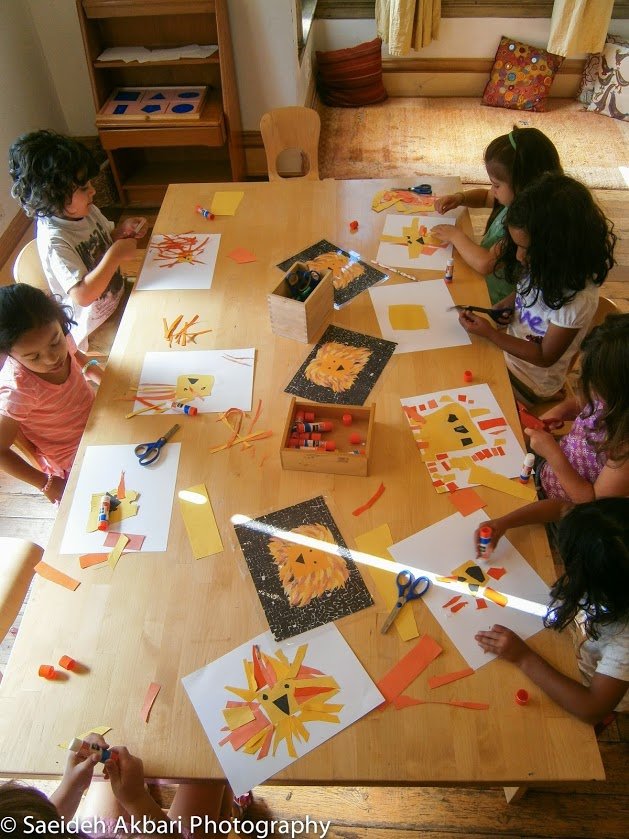
Most, though not all, models are repeated every year. Some are given a greater degree of complexity to adjust to the children’s growing developmental abilities. For example, in June (see below), while two-year-olds are given pre-cut pieces of paper to recreate the model’s lion’s mane in the collage, older children must cut their own pieces with scissors.
Why do it?
There are several reasons for doing the model art exercise:
1) It helps children develop strong hand-eye coordination.
2) It helps them practice producing work with an observable visual outcome (e.g. specific lines or different colors, gradients, or textures).
3) It is a visual representation of the theme the child is learning about that month and helps promote the breadth of their learning.
4) Helps refine the child’s fine motor development.
5) It provides parents and teachers benchmarks for evaluating a child’s growth in creative and technical skills over time.
6) Observing week-to-week variations is a good gauge of a child’s emotional state.
Model Art for Each Month Overview
This is just an overview, please do not use these samples, instead, please use the high resolution ones shared in this file.
Model Art for each Month Overview
After review over please access high resolution files here.